He has seen himself in this life
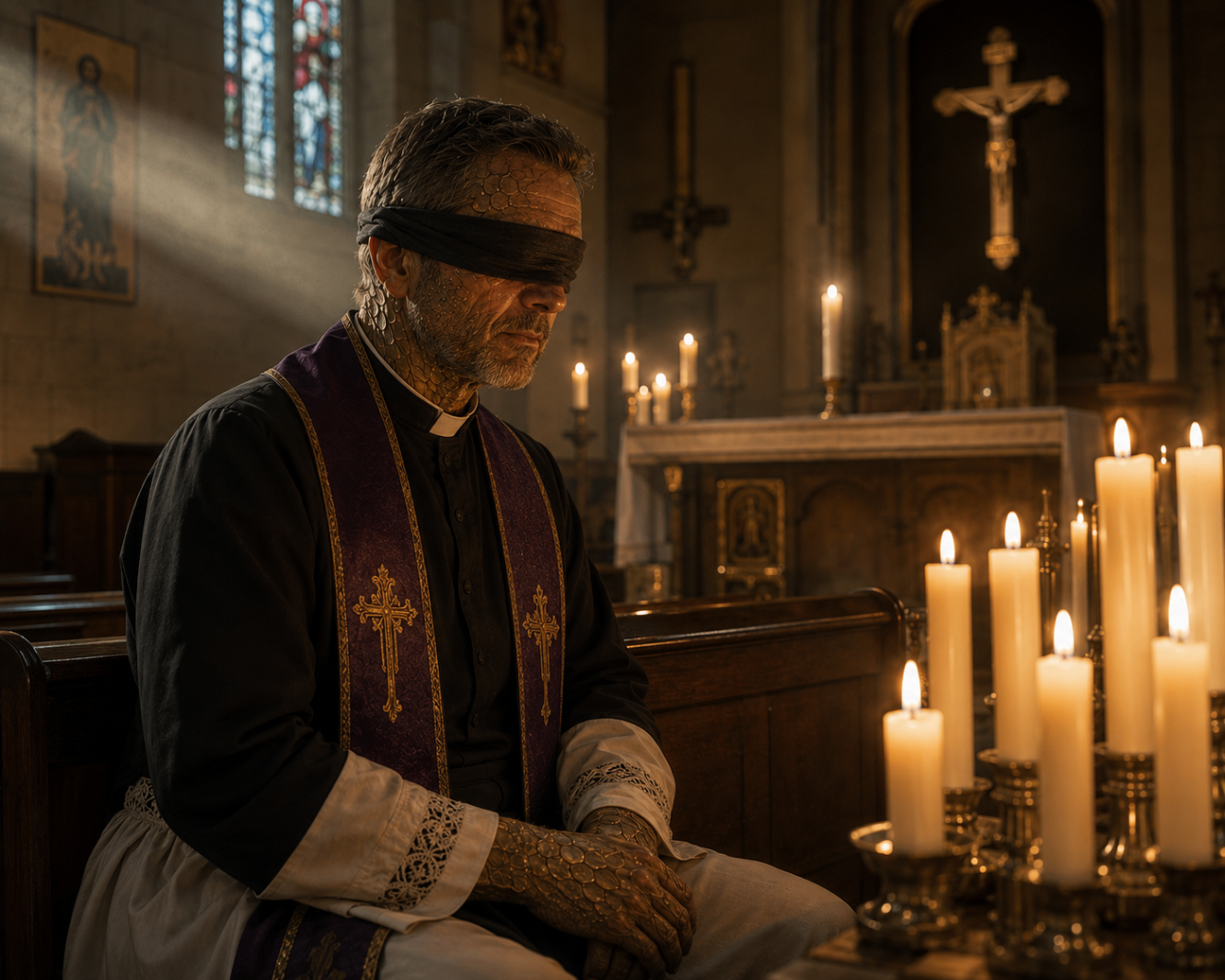
believing that he needs no eyes
to know who he is.
He has worn this life
the way he wears the vestments —
carefully,
by feel,
the way the blind dress,
with the gravity of someone
who understands
that what you put on
eventually
puts you on.
He came to the faith
the way he comes to everything,
without knowing he was coming.
Just arrived one day
at the door of it
and found it open
and went in
and stayed.
He is good at this.
The listening especially.
He can hold another person's doubt
like something fragile and necessary
without flinching
because something in him
recognizes it —
not the doubt of a man
who needs the answer to be yes —
but the older doubt.
The kind that doesn't need
an answer at all.
The kind that precedes
the question.
He doesn't know
where that comes from.
He has stopped asking.
At 3am
when the church empties
to its truest self
(stone and shadow
and the particular silence
of a space
that has absorbed
centuries of human need)
he sits in darkness.
Not praying exactly.
Something older than praying.
Something that praying
was built on top of
the way the cathedral
was built on top of
the older thing
nobody remembers
was there first.
He looks at the candles.
Even though he cannot see them.
This is the moment
he has learned
to be careful with.
The feel of fire
does something
to him
that he has never
found the words for
in any theology
he has studied
and he has studied
all of them.
Not comfort.
Not transcendence.
Recognition.
As if the fire knows him
in a way
his own face
in the mirror
does not.
He looks away.
He has built a life
on looking away.
Sunday mornings
he stands at the door
afterward:
waiting until, one-by-one, they grasp his hand.
Quietly, he receives the ordinary
confessions of ordinary lives,
the small guilt
and smaller redemptions
of people doing
their complicated best.
He loves them.
This surprises him
every time —
the sheer weight of it,
the tenderness
that moves through him
when Mrs. Abernethy
tells him again
about her son
who doesn't call,
when the boy
in the third pew
falls asleep
during the sermon
with such complete
surrender.
He cannot see the boy
but the incense of surrender
is sweet in the air.
He loves them
with something
that doesn't fit
the theology either.
Too old for that.
Too large.
The way a river
doesn't fit
the word river —
it just keeps
doing what it does
regardless of
what you call it.
Last Tuesday.
A funeral.
A young man.
Accident.
The family undone
in the particular way
families come undone
when the order of things
is violated.
He stood at the graveside
and said the words
he has said
a thousand times
and meant them
the way he always means them,
and then the wind came
off the hill
and something in it —
old.
Mineral.
The smell of deep stone
and open sky
and something burning
very far away —
moved through him
like a key
through a lock
he didn't know
he had.
Just for a moment.
A door.
Something on the other side of it
vast and specific and entirely without the comfort he has spent this life dispensing.
He stood at the grave and felt it — not God. Not the absence of God. Something that was there before that question was invented.
He closed his eyes.
When he opened them Mrs. Abernethy tugged the sleeve of his cassock.
Are you alright Father?
He smiled. Fumbled for her hand. Took her hand in both of his.
Yes, he said. Just the wind.
He has always been good at this: the true answer disguised
as the simple one.
Though he doesn't know
why that comes
so naturally.
He has never known why.
Yet.
Part VI